Last updated 2026-08-19
TL;DR
Radon mitigation is building work that lowers indoor radon, usually a sealed pipe and fan that vent soil gas outside. Start with a confirmed test (EPA's action level is 4 pCi/L), then check whether your state licenses the trade. NRPP or NRSB paper is the common national path. Local permits and a post-mitigation test close the job. Confirm forms and fees with the board that regulates you.
What is radon mitigation?
Radon mitigation is the building work that lowers indoor radon gas so occupants breathe less of it. In most U.S. houses that means a fan and a sealed pipe that pull soil gas from under a slab or crawl space and vent it above the roof. That is the job.
Radon is a colorless radioactive gas that forms from uranium in soil and rock. It rides with soil gas and collects in low, tight parts of a building. EPA estimates radon causes about 21,000 lung cancer deaths each year in the United States. [1] On the same page EPA calls radon the number one cause of lung cancer among non-smokers. [1]
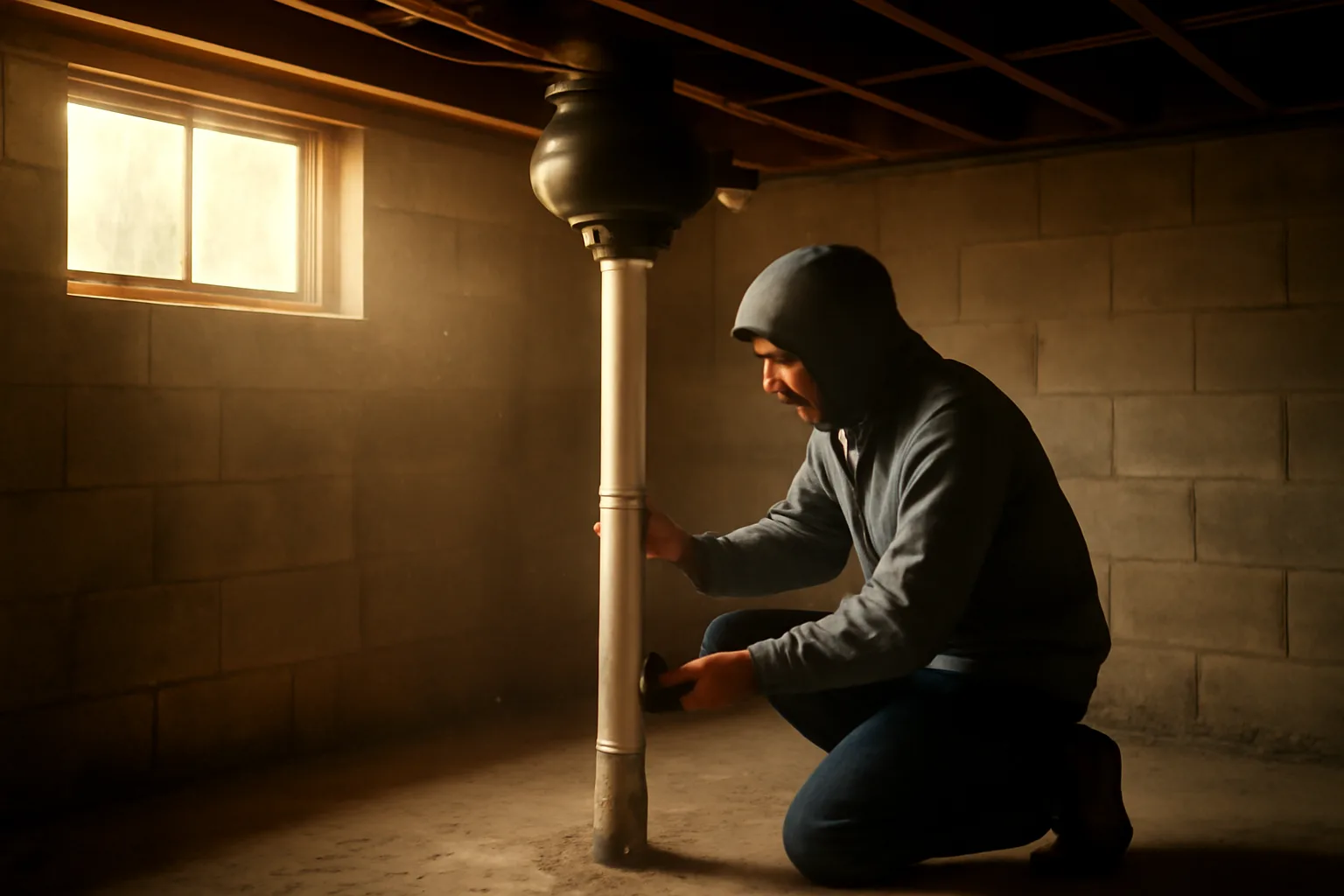
The usual system is active soil depressurization. A radon fan (attic or exterior) puts the soil side of the slab or membrane under a slight negative pressure. The pipe dumps the gas high enough that it does not wash back in. You seal the big openings so the fan works on soil gas, not room air. You leave a u-tube manometer on the riser so anyone can see the system is drawing.
Variants exist. Sub-membrane work on a crawl. Drain-tile suction. Block-wall suction on some old foundations. Heat recovery ventilators get sold as a fix. I would not lead with an HRV if the house will take a simple soil suction system. EPA's consumer materials describe that fan-and-pipe setup as the typical reduction method. [2]
Mitigation is not a test. Measurement is a different skill, and some states split the licenses so you cannot mark your own homework. Mitigation is also not a charcoal bowl or a plug-in gadget. If the bid has no fan and no sealed soil path, walk.
How do you start radon mitigation?
You start radon mitigation by confirming a measurement, then reading the statute in the state where the house sits. After that you get the certification or license paper that board actually accepts, pull any local permit, and only then cut concrete. Skipping the paper is how people get fined or watch a closing collapse.
If you are a homeowner, the start is shorter. Test. If the result sits at or above 4 pCi/L, hire a listed mitigator or learn enough to spot a bad bid. [3] EPA publishes a locator for measurement and mitigation professionals. [4]
If you are entering the trade, the start is a paper path, not a new truck. Read whether your state licenses testers, mitigators, or both. Illinois does, under the Radon Industry Licensing Act. [9] Ohio does, under Revised Code Chapter 3723. [10] Florida puts radon certification and real-estate disclosure in section 404.056, Florida Statutes. [8] Plenty of states still have no radon-specific license. That does not mean you can ignore building permits, electrical code, or the ANSI/AARST mitigation practice EPA points people toward. [5]
Then you take a course the receiving body accepts and you sit their exam. Nationally that is usually NRPP or NRSB. [12] Some states run an overlay on top. Nobody has a single national license. EPA does not license contractors.
I would not buy a trailer of fans until you know which exam your board wants. A class that is not on their list is money gone. Confirm the current application packet, fee, and insurance minimum with that board. Those numbers move. I will not invent them here.
What radon level means you should mitigate?
EPA's action level for indoor radon is 4 pCi/L. EPA also recommends that people consider fixing a home when the level sits between 2 pCi/L and 4 pCi/L. [1][3] That is the number set you will see on almost every U.S. bid sheet.
EPA's citizen guide is blunt. "Fix your home if your radon level is confirmed to be 4 picocuries per liter, pCi/L, or higher." [3] Confirmed matters. A short-term kit in a closed house is a screen. It is not always a closing document. Follow the device instructions and the measurement protocol your state named.
WHO uses a reference level of 100 Bq/m3, about 2.7 pCi/L. [7] WHO's fact sheet puts radon's share of lung cancers in a range of 3% to 14%, depending on the country and the smoking mix. [7] That is why some buyers push for work below 4. I still write bids against the EPA number unless the contract or the state says otherwise.
Do not mitigate off one wild short-term spike if you can retest. Do not refuse work at 3.8 if the client wants the WHO number and will pay. The science is a slope. The paper is a line.
Do you need a license to do radon mitigation?
Sometimes. It depends on the state, and city permits can apply even where the state is silent. EPA does not issue a radon contractor license. [4][5]
Illinois requires radon industry licensing. The Illinois Department of Public Health runs that program, and the statute is the Radon Industry Licensing Act (420 ILCS 44). [9] Ohio requires a license for radon testers, mitigation specialists, and mitigation contractors under Revised Code Chapter 3723. [10] Florida's section 404.056 is the statute people cite for radon certification and for the mandatory radon disclosure in real estate. [8] New Jersey certifies testers and mitigators through DEP. [13]
Other states have no radon-specific license. California is a common example people get wrong. You can still need a contractor license for the construction work, plus local mechanical or electrical permits. Nobody publishes a clean 50-state fee table that stays true. Boards change packets. Confirm with the board that will audit you.
Cross a state line and you start over. Reciprocity exists in spots and is a rumor in others. Ask the receiving board in writing.
National certification (NRPP or NRSB) is often the prerequisite a licensing state wants to see. It is not a substitute for that license. [12]
What papers do NRPP and NRSB actually issue?
NRPP and NRSB are private proficiency programs. They issue certifications for measurement and for mitigation after you finish an accepted course, pass an exam, and send them the application they currently publish. [12] They are not state boards. They are not EPA.
NRPP is tied to AARST. NRSB is the older parallel shop. Some states accept both. Some name one. A few run their own exam and treat national cards as optional. Read the state packet. Do not argue with a clerk using a Facebook thread.
I would pick the program your first two target states already list. Dual cards are fine later. In year one they are extra calendar time and extra renewal fees.
Neither card lets you skip local permits. Neither card is a contractor license. Keep the certificate PDF, the course roster, and the exam result where a board can see them. If your state wants a surety bond or a minimum insurance endorsement, that is a separate pile.
Fees, CE hours, and renewal cycles change. Confirm them on the current NRSB applicant page and on the state page. [12]
What does a first mitigation job look like on paper?
A first job that a board can reconstruct looks boring. That is the point. You want a folder (digital is fine) that holds the pre-mitigation measurement, the signed proposal, the permit, photos of the suction point and the discharge, a pressure-field note, the system label, the homeowner packet, and the post-mitigation test.
Diagnostics belong in that folder. A smoke check at a floor joint. A u-tube reading. A short note on communication under the slab. ANSI/AARST soil gas mitigation practice is what EPA lists as the current standard of practice. [5] If you cannot show you tried to get field extension, you are guessing.
Electrical needs a disconnect and a listing that will not embarrass you in an inspection. Discharge height and location have rules in the standard. Mark the pipe so the next tradesperson does not cut it. Manometer on the riser.
If you want a single binder of common NRPP-oriented forms and a first-year checklist, RadonPath publishes a $149 one-time NRPP Mitigation Kit. That kit is optional. The board that licenses you still owns the real list.
Do not invent a post-mitigation number. Use a listed device or a listed measurement pro, depending on your state's conflict rules. Some states will not let the mitigator run the clearance test. That is the statute, not a slight.
How much does a typical home radon mitigation system cost?
EPA's published typical home mitigation cost range is $800 to $2,500. [2] That range comes from EPA's Consumer's Guide to Radon Reduction. It is the last clear federal number I will put on this page. Labor and fan prices have moved since that guide. Treat $800 as historical, not a 2026 bid floor.
Crawl spaces with a full membrane run higher. Big footprints, poor sub-slab communication, and finishes you have to put back also run higher. A simple slab ranch with a decent stone layer is the cheap job. Anyone quoting a flat national number without seeing the soil side is selling a story.
State-level install pricing beats EPA's old band. If you need a market read, use radon mitigation cost in alabama, radon mitigation cost in arizona, radon mitigation cost in california, radon mitigation cost in colorado, radon mitigation cost in florida, or radon mitigation cost in georgia. Those pages are for planning. Your bid still comes from the house.
I would not race to the bottom on price in year one. Warranty callbacks eat the margin you thought you won.
Which states actually regulate radon mitigators?
A minority of states run a real radon license or certification program. Illinois, Ohio, Florida, and New Jersey are the ones I can point to with a statute or a program page in this article. [8][9][10][13] Several other states do too. I am not going to fake a 50-row table.
Here is a short, sourced cut.
| Place | What the paper actually is | Where to confirm |
|---|---|---|
| EPA | No contractor license. Action level and consumer guides. | EPA radon pages [1][4] |
| Illinois | Radon industry license through IDPH | Radon Industry Licensing Act [9] |
| Ohio | License under ORC Chapter 3723 | Ohio Revised Code [10] |
| Florida | Certification and disclosure under s. 404.056 | Florida Statutes [8] |
| New Jersey | DEP certification of testers and mitigators | NJ DEP radon professionals [13] |
| Many other states | No radon-specific license. Permits and contractor rules still apply. | State radon contact on EPA's locator [4] |
Florida's statute also forces a radon disclosure on real estate. The official text includes this line: "Radon is a naturally occurring radioactive gas that, when it has accumulated in a building in sufficient quantities, may present health risks to persons who are exposed to it over time." [8] That sentence is why every Florida closing packet looks the same.
If your state is not in that table, do not assume you are free. Call the state radon contact EPA lists and ask two questions. Do you license mitigators? Which national card do you accept? Get the answer in writing.
What standard do you follow on a mitigation job?
You follow the mitigation standard your state named. If they named nothing, you follow the ANSI/AARST soil gas mitigation practice EPA lists on its radon standards page. [5] EPA does not want you inventing a method in the field.
That standard covers diagnostics, pipe, fans, sealing, labeling, discharge, and documentation. It is dry reading. Read it anyway. The parts people skip (pressure field extension, labeling, electrical disconnect) are the parts inspectors pick at.
Local mechanical and electrical code still apply. A radon card does not override the city inspector who wants a permit for the fan circuit. I would pull the permit. Fighting a stop-work over a cheap permit is a bad trade.
CDC and NCI materials cover health risk, not pipe layout. Use them when a client asks why the fan matters. [6][14] Use the standard when you drill.
What should you buy in year one, and what is a waste?
Buy the tools that make diagnostics real. A micromanometer or at least a u-tube you trust, smoke, a drill that will survive slab work, PVC cement that matches the pipe, fans from a supplier who still answers the phone, and a labeled manometer for every job. Add a moisture meter if you do crawl membranes. Add liability insurance before the first deposit.
Waste of money in month one: a wrapped van, a custom CRM, a second storage unit, and any course your board does not list. Also a stack of radon-eating gadgets you plan to resell. You will eat them.
A thermal camera is nice. It is not required to start. I would wait until the simple tools feel boring.
Keep receipts. Some states want training records or device calibration certificates at renewal. Confirm the list. Do not mail them a pile they did not ask for.
If you work in multiple markets, price fans and membranes against those state cost pages rather than one national catalog. radon mitigation cost in connecticut and radon mitigation cost in delaware will not match a Colorado mountain house.
How do you document a mitigation so a board can confirm it?
You document it so a stranger can rebuild the job from the folder. Names, addresses, license numbers, device model and serial, pre and post results with dates, a floor sketch with the suction point, photos of the discharge and the manometer, permit number, and the standard you claim you followed.
Boards do not want a novel. They want confirmable facts. If the homeowner later sells, that same packet is what the buyer's inspector asks for. Put a weatherproof label on the system with your company name, contact, date, and the advice to keep the fan on.
If your state requires notification to the radiation program, send it. Late notifications are a cheap way to earn a complaint file.
I do not have good public data on how often boards audit first-year shops. The honest line is this: act like the file will be read, because a failed clearance or a noisy fan is what triggers the read.
What happens after the fan is running?
After the fan is running you still do not have a finished job. You need a post-mitigation test under the protocol your state or the standard requires. EPA tells homeowners to test again after mitigation and to retest at least every two years. [3] Fans die. Pipes get cut during a remodel.
Give the occupant a one-page sheet. Fan stays on. Check the manometer. Do not close the discharge. Call you if the u-tube goes flat. That sheet prevents half the callback noise.
If the post test is still over 4 pCi/L, you go back. More sealing, a second suction point, a different fan curve. Do not argue with the number. Fix the system.
NCI's radon fact sheet is a clean handout if someone wants the cancer mechanism in plain language. [14] CDC's radon page is the other short government explainer. [6]
If you want the NRPP-oriented kit mentioned earlier, the start page is /start. RadonPath is an independent publisher, not a law firm and not a mitigation company. Nothing here is an approval or a timing promise.
Where do people get radon mitigation wrong when they start?
They treat EPA like a licensing bureau. EPA writes risk numbers and consumer guides. It does not hand you a ticket to drill. [4]
They skip diagnostics and hope a louder fan covers a dead slab. A louder fan on a tight clay site just howls.
They mix measurement and mitigation in states that forbid it. Read the conflict rule.
They use the EPA $800 to $2,500 band as a current price list. [2] It is not.
They ignore crawl moisture. A membrane job that traps liquid water is a mold call, not a radon win.
They forget the electrical permit. Then they forget the label. Then they vanish when the house sells.
Start slower. Get the paper right. The pipe is the easy part.
Frequently asked questions
What is radon mitigation?
Radon mitigation is the building work that lowers indoor radon gas. In most houses that is a sealed pipe and fan that pull soil gas from under a slab or crawl space and vent it outside. Sealing, a manometer, and a post-mitigation test are part of a real job. Gadgets with no soil suction path are not mitigation.
How do you start radon mitigation?
Start with a confirmed radon measurement, then read the license rules in the state where the house sits. If you are entering the trade, take a course your board accepts, sit the NRPP or NRSB exam they name, and apply for any state card before you drill. Pull local permits. Confirm current fees and forms with that board. Do not invent a national license. There is not one.
What is EPA's radon action level?
EPA's action level for indoor radon is 4 pCi/L. EPA also says people should consider fixing a home between 2 pCi/L and 4 pCi/L. Those figures come from EPA's health-risk and citizen-guide pages. WHO uses a lower reference level of 100 Bq/m3 (about 2.7 pCi/L). Write the bid against the number your contract and your state actually use.
Does EPA license radon mitigators?
No. EPA sets risk guidance, publishes consumer guides, and lists state contacts and proficiency programs. It does not issue a contractor license. Licensing, if it exists, is a state statute plus local permits. National cards from NRPP or NRSB are private certifications. They are not an EPA ticket.
Do I need both NRPP and NRSB certification?
Usually no. Pick the program your first target states already accept, then add the second card later if a new market demands it. Dual certification is extra time and renewal work in year one. Confirm the accepted list on the state board page, not on a forum. Fees and CE rules change, so read the current applicant packet.
Can I mitigate my own house without a license?
In some states a homeowner can work on their own dwelling. In licensing states the statute may still restrict who may offer mitigation for pay, and some restrict even owner work. Local electrical and mechanical permits can apply either way. Read your state statute and ask the building department before you cut the slab. I would still want a listed post test.
How long does a radon mitigation system last?
The PVC and the suction pit can last for decades if nobody cuts the pipe. The fan is the wear part. Expect fan replacement on a multi-year cycle, not a forever cycle. EPA tells occupants to retest after mitigation and at least every two years because fans fail and houses change. Budget a fan, not a whole new system, when the manometer goes flat.
What is active soil depressurization?
Active soil depressurization is the usual radon mitigation method. A fan pulls soil gas from beneath a slab or a crawl membrane and vents it outdoors, keeping the soil side at a slight negative pressure relative to the house. Sealing large openings helps the fan work on soil gas instead of room air. It is the system EPA's consumer guide treats as typical.
Is a post-mitigation radon test required?
A clearance test is required by good practice and by many state programs, even when the statute is quiet. Some states will not let the mitigator run that test. Use a listed device and the protocol your board named. If the result is still at or above 4 pCi/L, go back and change the system. Do not argue with the number.
How often should you retest after mitigation?
EPA tells homeowners to test after the system is in and to retest at least every two years. Retest after a remodel that cuts pipes, after a fan swap, or if the manometer goes flat. A system that ran well in 2019 can be dead in 2026 and nobody notices until a sale. Put that retest advice on the homeowner sheet you leave behind.
What is the difference between radon testing and radon mitigation?
Testing measures the radon concentration in air. Mitigation changes the building so that concentration falls. They are different skills, different devices, and often different licenses. Some states split them on purpose to avoid a conflict of interest. A test kit is not a mitigation system. A fan in a pipe is not a measurement.
Can I use an HRV instead of a radon fan?
An HRV can dilute indoor air. It is not the first tool I would use on a house that will take soil suction. EPA's consumer materials describe fan-and-pipe soil depressurization as the typical fix. I would only open an HRV conversation after diagnostics show ASD will not work, or as a supplement the client understands is not the same system.
What should be on a radon system label?
Put a weatherproof label on the pipe or fan with company name, contact, install date, and a plain warning to keep the fan running. Add any license number your state wants visible. The point is that a future inspector or buyer can tell what the pipe is and who to call. Confirm any extra wording with your board and the mitigation standard you follow.
Does Florida require a radon disclosure?
Yes. Section 404.056, Florida Statutes, includes the radon notification used in real estate and also frames Florida's radon certification rules. The statutory notice states that radon is a naturally occurring radioactive gas that may present health risks when it accumulates. Confirm the current disclosure form and mitigator certification steps with Florida DOH, not with a memory of last year's packet.
Sources
- U.S. EPA, Health Risk of Radon: EPA estimates about 21,000 U.S. lung cancer deaths per year from radon, names radon the leading cause among non-smokers, sets the 4 pCi/L action level, and advises considering fixes between 2 and 4 pCi/L.
- U.S. EPA, Consumer's Guide to Radon Reduction: EPA describes typical home radon reduction methods and publishes a typical system cost range of $800 to $2,500.
- U.S. EPA, Find a Radon Test Kit or Measurement and Mitigation Professional: EPA maintains a locator for radon measurement and mitigation professionals and state contacts; EPA itself is not the licensing authority.
- U.S. EPA, Radon Standards of Practice: EPA points practitioners to current ANSI/AARST radon standards of practice for mitigation and measurement work.
- CDC, About Radon: CDC's radon page explains indoor radon as a health hazard and a leading cause of lung cancer after smoking.
- World Health Organization, Radon and Health fact sheet: WHO sets a reference level of 100 Bq/m3 and attributes an estimated 3% to 14% of lung cancers to radon, depending on country and smoking mix.
- Florida Statutes s. 404.056 (2023): Florida law contains the statutory radon notification language used in real estate and the state's radon certification framework.
- Ohio Revised Code Chapter 3723: Ohio law requires licensure for radon testers, mitigation specialists, and mitigation contractors.
- National Radon Safety Board, Certification: NRSB publishes its certification path for radon measurement and mitigation professionals; NRPP through AARST runs a parallel national program.
- New Jersey DEP, Radon Professionals: New Jersey DEP certifies radon testers and mitigators and publishes the professional program page.
- National Cancer Institute, Radon and Cancer fact sheet: NCI's fact sheet states that radon is a radioactive gas and a cause of lung cancer.