Last updated 2026-08-19
TL;DR
Radon mitigation lowers indoor radon, usually with an active soil depressurization system, after a test shows the building is at or above EPA's action level of 4 pCi/L. You start by checking whether your state licenses mitigators, taking an approved course, sitting the exam your board names, and only then pulling permits and installing. National myths skip the state paper. Confirm every fee with that board.
What is radon mitigation?
Radon mitigation is the work of lowering indoor radon, usually with an active soil depressurization system (a fan, pipe, and suction point) plus a post-test that proves the number dropped. It is not a lab test. It is not a sealant sold as a cure. You change the building, then you measure again. [3]
That is the whole trade in one paragraph. People dress it up.
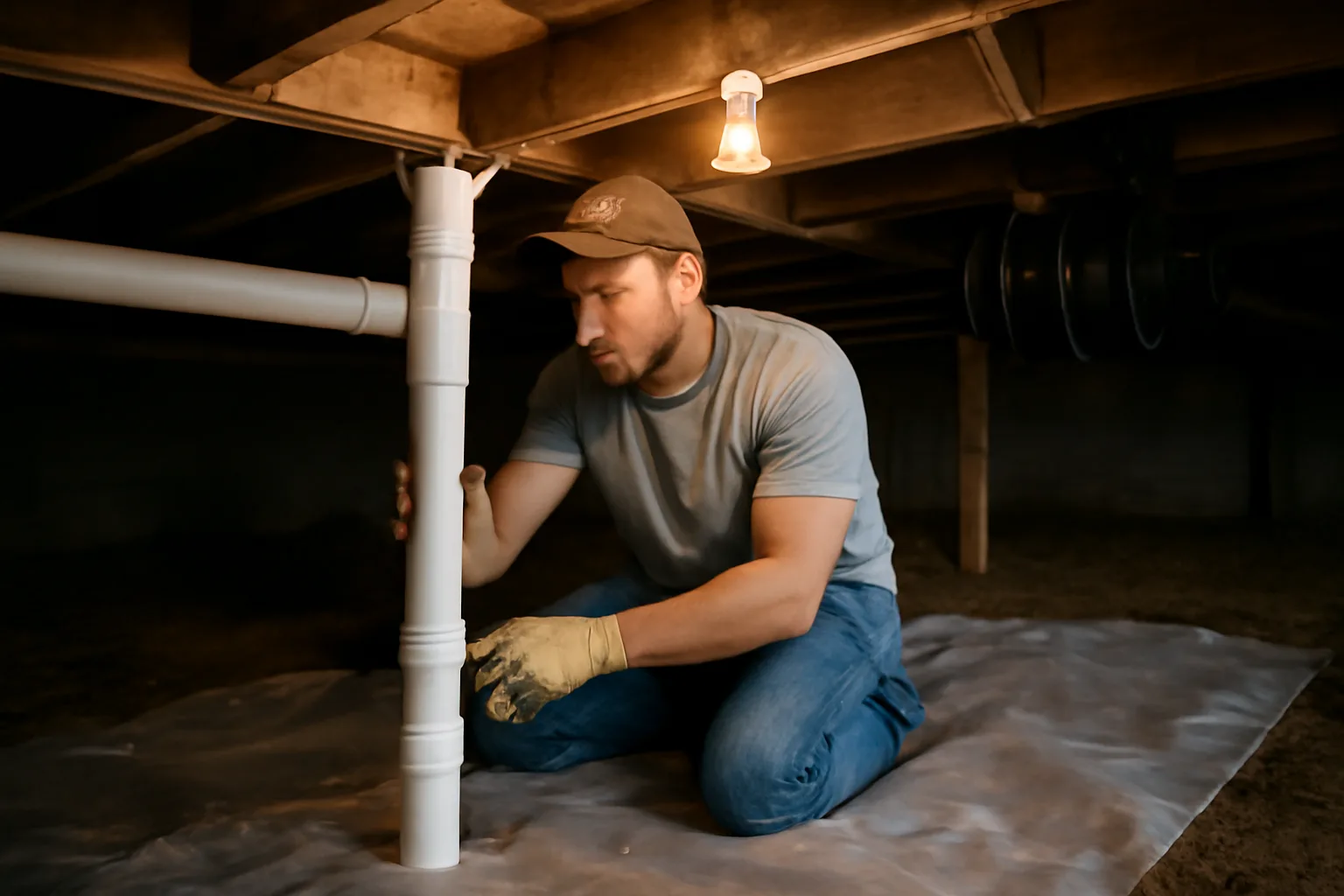
The usual system is simple hardware. You cut a suction pit in the slab, or you tie into drain tile or a sealed sump. You run PVC to a quiet inline fan. You exhaust above the roof edge, away from windows. You seal big openings because you want the fan to pull on the soil, not on the basement air. You leave a manometer on the pipe. Crawl-space houses get a sealed membrane and suction under that sheet. Some new houses already have a passive stack, so you add the fan and treat it like any other active system.
EPA walks through these options in the Consumer's Guide to Radon Reduction. That guide is written for homeowners, but it is also the document buyers will quote back at you on the job. Read it before your first bid. [3]
Radon is a radioactive gas from uranium in soil and rock. You cannot see it. The ATSDR radon fact sheet and the National Cancer Institute both put it in the lung cancer column, not the musty basement smell column. [13][12] Mitigation exists because the gas keeps coming. Sealing cracks alone rarely holds a high house down.
I would not sell furnace filters, ozone boxes, or radon candles as mitigation. Dilution with outdoor air can nick a low number. It is a weak plan for a 10 pCi/L slab house. If a salesperson leads with a spray-on product and no fan, that is not radon mitigation.
Lock this definition. You install a designed pressure change. You document it. You retest.
How do you start radon mitigation?
You start by reading the rule that binds your state, then you take the course and exam that rule names, then you file the board's application and any contractor license your city or state also wants. You do not start by ordering fans in bulk. National certification is real, and it is not a magic passport. Confirm every form and fee with the board that will fine you. [7][11]
Here is the order I would actually follow.
Look up the state radon program from EPA's state contact list, then open the statute or code that program cites. [11] Write down whether they license measurement, mitigation, or both. Write down whether they accept NRPP, NRSB, their own exam, or some mix. Florida requires certification under Statute 404.056, whose official title names "certification of persons performing measurement or mitigation services." [7] California does not run that same kind of statewide radon mitigator card. You may still need a contractor license for the construction work. Confirm it.
Take the listed training. Sit NRPP, NRSB, or the state exam, whichever the packet requires. [8][9] Buy the insurance customers and GCs will ask for. Learn the installation standard cited in your rule. Then bid a house that already has a test you trust. Kansas State University's National Radon Program Services mitigation page is a decent plain-language companion while you read the legal text. It is not a substitute for the statute. [10]
Working two states means two reads. The Florida radon mitigation board packet will not cover Arizona or Colorado. Reciprocity is a question you ask the second board, in writing.
Skip the van wrap. Skip the custom logo cups. Your first year is paper and a few clean installs, not a brand launch. Do not plan your calendar around a processing time you saw in a forum. Those posts go stale. Call the board.
What radon number means you should mitigate?
EPA's action level is 4 pCi/L. EPA recommends fixing a home if one long-term test or the average of two short-term tests shows 4 pCi/L or higher. That is the sentence buyers, agents, and inspectors will repeat to you. [1]
On the action-level page EPA states, "EPA recommends fixing your home if the results of one long-term test or the average of two short-term tests show radon levels of 4 pCi/L or higher." Memorize it. Put it on the proposal. [1]
EPA also says to consider fixing between 2 and 4 pCi/L. I treat 3.5 like a house that will come back. You can wait. The client often will not, especially if a contract already named 4.0 as the walk-away line.
WHO sets a national reference level of 100 Bq/m3, about 2.7 pCi/L. WHO states, "Radon is a major cause of lung cancer." Different agencies, different lines. Your contract should say which line you are designing to, because a system that meets EPA can still sit above the WHO figure. [6]
Units mix people up. 4 pCi/L is 148 Bq/m3. If a lab report lands in Bq/m3 and you bid like it was pCi/L, you will look reckless. Convert once. Write both units on the proposal.
Testing quality matters more than the logo on the kit. Closed-house conditions, right placement, right duration. A two-day charcoal test in an open-window week is a weak trigger for a multi-thousand-dollar fan. I would rather see a long-term test or a well-run continuous monitor. The Citizen's Guide is still the plain-language version of how to test before you cut a slab. [4]
Do not mitigate off a neighbor's number. Test that building.
Do you need a state license or is NRPP enough?
It depends on the state, and only the state packet answers it. NRPP and NRSB are national proficiency programs. They are not federal licenses. EPA does not issue a mitigator card. [8][9][11]
Some states require their own certificate and will accept NRPP or NRSB as part of that file. Some write their own exam. Some require no radon credential at all, and the only card that matters is a contractor license or a local business tax receipt. Alabama's radon mitigation board picture is not Florida's. Connecticut and Georgia each have their own paper. Read yours.
I would still sit NRPP or NRSB even in a no-state-card market if I wanted GCs and national home warranties to return my calls. That is a business choice, not a law.
| Credential | Who issues it | What it proves | When it is enough by itself |
|---|---|---|---|
| State radon certificate | Your state program | You met that state's statute or code | In states that require it, this is the one that keeps you legal |
| NRPP mitigation listing | NRPP (AARST proficiency) | You passed listed training and their exam | Only where the state does not require its own card, or where the state accepts it as the credential |
| NRSB certification | National Radon Safety Board | Same idea, different board | Same limit as NRPP |
| Contractor license | State or local contractor board | You may pull permits and contract | Often required in addition to radon paper |
Nobody has a clean national count of how many states sit in each row this year. Programs change. Confirm.
If a trainer says NRPP is accepted everywhere, ask them to show the regulation. Then read it anyway. EPA's find-a-professional page is a consumer locator, not a license. [14]
What training and exam do new mitigators take?
You take the residential mitigation course your board or proficiency program lists, then you sit that program's exam. Hour counts and device lists change. Confirm the current outline with NRPP, NRSB, or the state training page before you pay a school. [8][9]
Most people start with a residential mitigation class, not a diagnostics seminar. Measurement is a separate credential in a lot of programs. If you will test and mitigate, budget for both tracks. I would not take a weekend combo from a no-name shop that cannot show you their listing on the NRPP or state roster.
The exam is multiple choice plus the standard. You will see soil-gas entry, fan talk, pipe routing, electrical disconnects, discharge clearances, and a pile of what-is-wrong-with-this-photo items. Study the installation standard more than the marketing slides.
After you pass, the application is its own pile. Photos, affidavits, insurance, sometimes a background check. I will not quote a fee. Boards change fees. The only honest line is this: use the fee page the board published, and call if the PDF and the portal disagree.
Continuing education is real in listed programs. Put the renewal date on a wall. Lapsed cards are how people lose a closing.
Waste of money: laminated certificates from equipment vendors that are not on the approved list. Hang them in the shop if you want. Do not put them on a bid. Another waste: paying twice for the same course because you booked before you checked whether your state wants its own add-on module.
What does a first mitigation job actually look like?
A first job is a pre-test you trust, a walkthrough, a written proposal, a permit if the city wants one, a day of core drilling and pipe, a fan on a switch, sealing, a label, a manometer, and a post-test. Miss any of those and you do not have a finished job. [3]
Walk the house before you bid. Slab on grade, basement, crawl, or mix. Sump. French drain. HVAC in the basement. Knee walls. Additions on different foundations. The pretty ranch with three slabs is the one that makes new techs miss a suction field.
I bid after I know where the discharge can go without dumping gas at a bedroom window. I also want to know if the electrical panel has a spare slot. Borrowed power from a random outlet is how you get a callback and a cranky electrician.
Install day is dusty and loud. Core the slab, dig a pit, set pipe, hang the fan, seal the sump, run silicone at the big cracks you can actually reach. You will not caulk the entire world. Do not promise that.
Then you wait for the post-test window the standard calls for. Leave the system on. If the number is still high, you diagnose. Extra suction points, a bigger fan, a hidden crawl. That second trip is part of the trade. Price some of it into the first bid or you will resent the house.
Homeowners will ask if they can just seal the cracks. Show them EPA's own ranking of methods in the Consumer's Guide. Fan and pipe wins on a soil-gas house. [3] EPA also still points consumers to listed measurement and mitigation professionals rather than random handymen. Use that page the way buyers will. [14]
What paper do you keep in year one?
You keep the contract, the pre-test, the permit, the system sketch, fan model and serial, pressure reading, photos, the post-test, and the homeowner packet with your license or listing number on it. If your state requires a specific notice or label, that goes on the pipe, not in a drawer. Boards ask for files when something goes wrong. [7]
Write the scope in plain verbs. Install one ASD system on the basement slab, seal the sump, exhaust above the eave on the north wall, leave a manometer, retest. Do not write a novel. Do not write that you will eliminate radon. You lower it. You do not sign a chemistry guarantee.
Insurance certificates, workers-comp if you have staff, and the contractor license copy ride along with every GC packet. Scan them once. Stop emailing a photo of a crumpled COI.
Some people keep that stack in a cardboard box and they are fine. If you want a pre-built forms set, RadonPath sells a $149 one-time NRPP Mitigation Kit. A binder and the statute work too. I care that you can find last March's post-test when a buyer attorney asks.
Invoices should match the proposal. Change orders should exist when you add a second suction point. Verbal yeah-go-ahead disappears at closing.
Hold customer radon numbers like medical data. Do not post before-and-after screenshots with house numbers in the background. Florida's statute also ties radon to real-estate notification rules, which is a reminder that your file can show up in a closing packet, more than in your truck. [7]
How much does a typical mitigation system cost the homeowner?
EPA's Consumer's Guide has long used about $1,200 as a typical installed cost, with a common range of about $800 to $2,500. That is a national talking range, not your market. Big houses, block walls, and failed first attempts sit above it. Simple basement slabs sit near it. [3]
Your price is labor, travel, fan, pipe, electrical, permit, the post-test, warranty reserve, and the risk of a second suction point. Bid $799 to win a listing photo and you will skip the permit and the retest. That is how people exit this trade.
I would not publish a fixed menu in year one. Walk the house. Then write a number. If a listing agent demands a price from a photo, decline or give a wide range and say it is not a bid.
For your own overhead, nobody publishes a clean first-year P&L for mitigators. The closest honest inputs are your insurance quote, your board's fee page, truck insurance, and what fans actually cost from a vendor this month. Confirm those. I will not invent them.
Commercial and multifamily are a different bid. Different standard, more paper, more liability. Do not use the $1,200 house figure on a 40-unit building.
Buyers will still quote EPA's range at you. Let them. Then show the extras on that specific house. A crawl membrane, a long chase, and an electrician are not in the average.
What standards do boards expect you to follow?
Most boards point to a current ANSI/AARST soil-gas mitigation standard for existing homes, or to ASTM E2121, or they write pieces of those into state code. Your job is to use the edition named in the rule, not the PDF a friend texted in 2019. [3][8]
Those standards cover discharge height and distance from openings, fan location (outside or in an unconditioned space, not a bedroom), labeling, electrical disconnect, pipe slope, and post-mitigation testing. They also tell you when a crawl-space membrane is the system, not a suggestion.
EPA's consumer documents describe methods. They are not a substitute for the installation standard. If a city inspector has adopted the standard, the inspector wins on the jobsite. Argue later, with the text in your hand.
I study discharge clearances more than any other page. That is the item neighbors notice and the item that gets you a complaint. Second is electrical. Third is a fan buried in a crawl with no service access.
If your state is silent on the edition date, ask the program in writing which document they enforce. Keep the email. NRPP and NRSB applications assume you are working to the listed standard, not to shop folklore. [8][9]
A labeled pipe and a live manometer are the two things a later inspector can check in thirty seconds. Do not leave without both.
What should you skip in year one?
Skip gadgets that are not in the standard, skip working out of state on one card, and skip promising zero radon. A $20,000 wrap on a van with no permit history is also a bad buy.
I would not purchase every diagnostic toy on day one. A micromanometer, a good drill, a vac, PPE, and a way to measure post-mitigation will carry you. Fancy blower-door theater is for later.
Do not run measurement and mitigation on the same house without reading the conflict rules. Some states bar you from testing a house you will mitigate, or they require an independent post-test. That is ethics and, in some places, law. Confirm.
Do not hire three helpers cash and call it a crew. Wage and insurance problems show up right when a job goes bad.
Social media before-and-after shots with a two-hour charcoal kit in the discharge stream are a joke. You will get laughed at by people you want as referral sources.
The other skip: waiting six months to read the statute because a trainer said they covered it. They did not. EPA's 2003 risk assessment is why this work exists in public-health language at all. It is not a reason to skip the local application. [5]
How do you confirm your state's board rules?
You confirm board rules by reading the statute or code section, then the program's current application and fee page, then calling or emailing that program with a written question when those two disagree. EPA's state contact list is the starting index, not the rule. [11]
Print the PDF. Note the edition date. If the portal says something the PDF does not, ask which one they will enforce. Save the reply.
Local building departments are a second board in practice. Some cities want a mechanical permit for the fan. Some want nothing. The city counter is not listed on the state radon page. You find out by asking that city.
For a first map of how different states even talk about this, read a few state explainers and then go back to primary text. The Florida writeup and the California writeup are a useful contrast. So are Connecticut and Alabama.
I would not use a Facebook poll as confirmation. I would not use a vendor webinar as confirmation. K-State's mitigation explainer can help you learn the vocabulary. Then you still open the code. [10]
If two techs give you two answers, the written board page wins. If the board page is silent, ask the board. Do not fill the silence with a national myth.
What happens after the fan is on?
After the fan is on you verify suction, label the system, give the owner the packet, run the post-test on the schedule the standard names, and you stay on the hook for callbacks your warranty covers. A spinning fan is not a passing house. [3][4]
Watch the manometer with the owner standing there. If it reads like a dead stick, fix it before you leave. Show them the disconnect. Tell them the fan is a wear part. Fans fail. That is normal. A quiet house after two years is a callback, not a mystery.
EPA estimates radon is responsible for about 21,000 lung cancer deaths every year in the United States. About 2,900 of those deaths are in people who never smoked. That is why the post-test is not optional theater. [2][5]
If the post-test fails, you diagnose. You do not argue with the lab. Extra suction, sealed leaks you missed, a crawl you treated like a closet. Then you test again.
Long term, remind owners to test every two years or after major weatherization. The Citizen's Guide tells people to retest after mitigation and periodically after that. Put that line in the packet so you are not the only one who remembers. [4]
RadonPath is an independent publisher, not a law firm and not a service company. If you want the forms pack, it is at /start. The board still owns the last word on fees, quotas, and timing. Nobody here can approve you.
Frequently asked questions
What is radon mitigation?
Radon mitigation is the building work that lowers indoor radon, usually an active soil depressurization system with a fan, pipe, and suction point, followed by a post-test. It is not a charcoal kit and it is not a sealant sold as a cure. EPA describes the common methods in the Consumer's Guide to Radon Reduction. You change pressure under the house so soil gas stops entering.
How do you start radon mitigation?
Start with your state rule, not a national blog. See if mitigators need a state certificate, a contractor license, both, or neither. Take the course that board or NRPP or NRSB lists, sit that exam, file the published application, get insurance, then pull any local permit. Confirm fees with the board. Do not invent a processing time from a forum post.
Is NRPP the same as a state radon license?
No. NRPP is a national proficiency listing. A state license or certificate is what a statute or code creates. Some states accept NRPP as part of their file. Some ignore it and write their own exam. Some have no radon card at all. EPA does not issue a federal mitigator license. Read the state packet you will actually be judged on.
What is EPA's radon action level?
EPA's action level is 4 pCi/L. EPA recommends fixing a home if one long-term test or the average of two short-term tests is 4 pCi/L or higher. EPA also says to consider action between 2 and 4 pCi/L. WHO uses a 100 Bq/m3 reference, about 2.7 pCi/L. Put the line you are designing to in the contract.
Do I need a contractor license as well as radon paper?
Often yes, and the contractor board is a different office than the radon program. Cities may also want a mechanical or building permit for the fan. California is a good example of a market where radon-specific statewide cards are thin and contractor rules still matter. Confirm both stacks before you bid paid work.
Can I mitigate my own house without a license?
Owner-occupant rules vary. Some states regulate anyone who performs mitigation for others and stay quieter on DIY. Some cities still want a permit for the electrical and the penetration. Even on your own house, a bad discharge next to a window is a health miss. Read the statute and ask the building department before you core the slab.
How long is the mitigation training course?
Course length is set by the listing body and your state, and it changes. Do not trust a screenshot of last year's flyer. Confirm hours and the current outline with NRPP, NRSB, or the state training page before you pay. Measurement is often a separate track. Budget for both if you plan to test and install.
Do I need a building permit for a radon fan?
Many cities treat the fan and the roof penetration like mechanical work and want a permit. Some want nothing. The state radon page usually will not list every city counter. Call the jurisdiction on the job address. If they want a permit, pull it before you drill. Inspectors remember the people who skip them.
How should I price a first radon mitigation job?
Walk the house, then write a number. EPA's long-used talking range is about $800 to $2,500, with $1,200 as a typical figure, but that is not your market and not a 40-unit building. Include labor, travel, parts, electrical, permit, post-test, and a reserve for a second suction point. A $799 internet bid usually means a skipped retest.
What is a manometer and why do boards care?
A manometer (often a U-tube on the pipe) shows that the system is pulling. Owners can see it without tools. Standards and a lot of inspectors want that live indicator plus a label on the pipe. If the fluid is flat, the fan is dead or the tubing is off. Fix it before you leave. It is the cheapest honesty device on the job.
Can I work across state lines on one NRPP card?
Not safely, and often not legally. NRPP or NRSB may travel as a proficiency listing, but the second state may still want its own certificate, a contractor license, or both. Reciprocity is a board question. Ask the second state in writing. Florida paper does not cover Alabama or Colorado on its own.
Where do I confirm fees, quotas, and processing times?
On the board's current fee and application page, then by calling that office if the PDF and the portal disagree. I will not invent a fee or a wait time. National kits and articles go stale. EPA's state contact list gets you to the program. The program's own form is the only number that counts.
Is a short-term charcoal test enough before I install?
Sometimes it is enough for a contract, and sometimes it is a weak trigger. EPA's fix line can be met with one long-term test or the average of two short-term tests at 4 pCi/L or higher. Closed-house conditions still matter. I would not cut a slab off a two-day kit run with the windows open. Retest after the system runs.
What fan should I buy first?
Buy a radon-rated inline fan sized to the suction field you actually have, with a disconnect and a replacement path. Do not start with the loudest shop vac on a timer. Match the fan to slab tightness and pipe layout after you walk the house. Keep the model and serial in the job file. Fans are wear parts. Tell the owner that on day one.
Sources
- U.S. EPA, What is EPA's action level for radon and what does it mean?: EPA recommends fixing a home if one long-term test or the average of two short-term tests shows 4 pCi/L or higher.
- U.S. EPA, Health Risk of Radon: EPA estimates radon is responsible for about 21,000 U.S. lung cancer deaths per year, including about 2,900 among people who never smoked.
- U.S. EPA, Consumer's Guide to Radon Reduction: EPA describes common mitigation methods and has long cited a typical installed cost of about $1,200 with a common range of about $800 to $2,500.
- U.S. EPA, EPA 402-R-03-003 Assessment of Risks from Radon in Homes: EPA's 2003 radon risk assessment is the source document behind the widely cited U.S. lung-cancer death estimate.
- World Health Organization, Radon and health fact sheet: WHO identifies radon as a major cause of lung cancer and sets a recommended national reference level of 100 Bq/m3.
- Florida Senate, Florida Statute 404.056 (2023): Florida law 404.056 names certification of persons performing radon measurement or mitigation services, plus related testing and real-estate notification rules.
- American Association of Radon Scientists and Technologists, National Radon Proficiency Program: NRPP lists approved mitigation training and administers the proficiency exam that many states accept.
- National Radon Safety Board: NRSB is a separate national board that certifies radon measurement and mitigation professionals.
- Kansas State University National Radon Program Services, Mitigation: K-State's EPA-supported National Radon Program Services explains common mitigation methods in plain language for the public and new practitioners.
- National Cancer Institute, Radon: NCI identifies radon as a lung-cancer risk and as the second leading cause of lung cancer in the United States.
- ATSDR, ToxFAQs for Radon: ATSDR's radon ToxFAQs describe radon as a radioactive soil gas and outline exposure and health-effect basics.
- U.S. EPA, Find a Radon Test Kit or Measurement and Mitigation Professional: EPA directs consumers to listed measurement and mitigation professionals rather than treating any contractor as automatically qualified.