Last updated 2026-08-18
TL;DR
Starting radon mitigation in Alaska needs no state license, because there isn't one. You do need national certification (NRPP or NRSB), an Alaska business license ($50 a year), and general liability insurance. Training takes 1 to 3 months. Residential jobs typically run a single day, with homeowners paying $1,500 to $3,000. Alaska's high radon levels keep demand steady, but you'll face cold-climate install quirks and a small, word-of-mouth market.
Do I need a radon mitigation license in Alaska?
No state license exists for radon mitigation in Alaska. The Alaska Department of Environmental Conservation (DEC) runs a radon awareness program but does not certify, test, or license radon professionals. The agency's own guidance puts it plainly: “Alaska does not have a radon professional certification or licensing program.” [1]
So there's no state exam, no state fee, and no board to answer to. You won't find a “radon mitigation license Alaska” form at any state office. But walking onto a job site with no certification is a fast way to lose credibility and, worse, your ability to buy liability insurance.
What you actually need is a national certification from the National Radon Proficiency Program (NRPP) or the National Radon Safety Board (NRSB). Both are recognized by the U.S. Environmental Protection Agency and most insurance carriers. If you're serious about this business, those certifications are the minimum entry ticket, not a nice-to-have. Separately, you need a general Alaska business license, which I cover below.
Why does a radon mitigation market exist in Alaska?
Alaska has some of the highest predicted indoor radon levels in the country. The EPA's Radon Zone map classifies nearly all of the state's populated areas as Zone 1, meaning predicted average indoor screening levels above 4 pCi/L [2]. Testing data backs that up. Alaska DEC reports more than 1 in 3 homes tested in the state have radon at or above the EPA action level of 4 pCi/L [3].
That's a real public health problem. Radon is the second leading cause of lung cancer after smoking. In a state with long winters where homes stay sealed tight for months, gas builds up. Granite-rich geology plus airtight construction keeps mitigation demand consistent, even with only about 740,000 people statewide.
Those numbers are your marketing pitch. Home buyers in Anchorage, Fairbanks, and Juneau increasingly ask for radon tests during real estate deals. Inspectors and agents are a primary referral source, and they need certified mitigators to finish the work.
How do I register my business and get an Alaska business license?
Before you install your first fan, you need a legal business entity. Alaska requires all businesses, including sole proprietors, to hold a valid business license from the Department of Commerce, Community, and Economic Development (DCCED) [4]. The license costs $50 a year for a sole proprietor or single-member LLC, a fee that hasn't moved in years [5]. You can apply online through the DCCED Business Licensing portal in about 15 minutes.
There's no trade exam, no background check beyond the standard, and no proof of insurance required at the licensing stage. The state wants its $50 and a basic registration. Don't skip it. Operating without a business license can cost you fines and makes it hard to enforce contracts in small claims court. You renew annually.
If you form an LLC or corporation, you file articles with the Division of Corporations, Business and Professional Licensing first, then get the business license. Either way, the license number goes on your invoices, contracts, and advertising.
Do I need national certification for radon mitigation in Alaska?
Neither NRPP nor NRSB certification is state-mandated in Alaska. You could legally take a job tomorrow with no credential. But you won't get liability insurance, you won't land on any realtor's referral list, and if you drill through a homeowner's radiant floor heat by mistake, that repair comes out of your pocket.
NRPP mitigation certification is the wider-used track. It starts with an approved training course, 16 to 20 hours, covering radon chemistry, building science, mitigation standards (ASTM E2121), and fan sizing. Some people attend in-person workshops. Many use self-study. RadonPath sells a $149 NRPP Mitigation Kit that bundles the full course, practice exams, and field reference guides, and it takes about three weeks of evenings to finish.
After the course, you sit the NRPP Mitigation Certification exam, offered at computer-based testing centers or by live online proctoring. The exam has a 75% passing threshold. Once passed, you submit a mitigation system installation report, signed off by a mentor or experienced mitigator, to complete certification. Start to certified runs 1 to 3 months. NRSB follows a similar path of exam plus field experience [9]. Both require annual continuing education credits (16 hours for NRPP) and a renewal fee.
How much does radon mitigation cost in Alaska?
Alaska DEC pegs the cost of a residential radon mitigation system at $1,500 to $3,000, depending on home size, foundation type, and system design [6]. That's higher than the national average of about $1,200 reported by the EPA [7], and for good reason. Many Alaskan homes sit on permafrost-adjacent soils, have large crawlspaces, or need extra insulation and drain-line thaw prevention a contractor in Georgia never touches.
As a new contractor, that $1,500 to $3,000 range tells you what you can charge. Most independent mitigators in Alaska price jobs between $2,000 and $2,500, with the low end for a straightforward slab-on-grade and the high end for crawlspace encapsulation plus exterior drainage. Remote villages and off-road communities push higher because of travel and logistics.
Your direct material cost for an active soil depressurization system runs $400 to $800: quality fan, PVC pipe, couplings, sealant, manometer, discharge fittings. The rest is labor, overhead, and profit. A one-person shop doing two jobs a week at a $2,200 average grosses about $4,400 weekly. That's a livable business in Alaska, even after insurance, marketing, and vehicle costs. The chart below compares the Alaska midpoint against the national average install cost.
How long does radon mitigation take in Alaska?
A standard sub-slab depressurization install in an occupied home takes one working day, roughly six to eight hours from arrival to final walkthrough. That hasn't changed much in decades. Complex jobs, like a home with multiple foundation types or an exterior footing drain retrofit in frozen soil, can stretch to two days.
Alaska's cold rarely adds time to the core install, since PVC pipe and sealants handle it fine, but it does compress the building season. In Fairbanks or the Mat-Su Valley, outdoor excavation is realistically a May-through-October job. Interior work through an existing slab happens year-round as long as the crawlspace or basement is reachable. Many Alaska mitigators stack outdoor installs back-to-back in summer and do indoor-only work through winter.
Post-mitigation follow-up testing (48 hours of closed-house conditions) adds no onsite time. You leave a short-term test device and the homeowner mails it to a lab. Your billable hours per job are mostly that single day.
What radon mitigation system will I install every day?
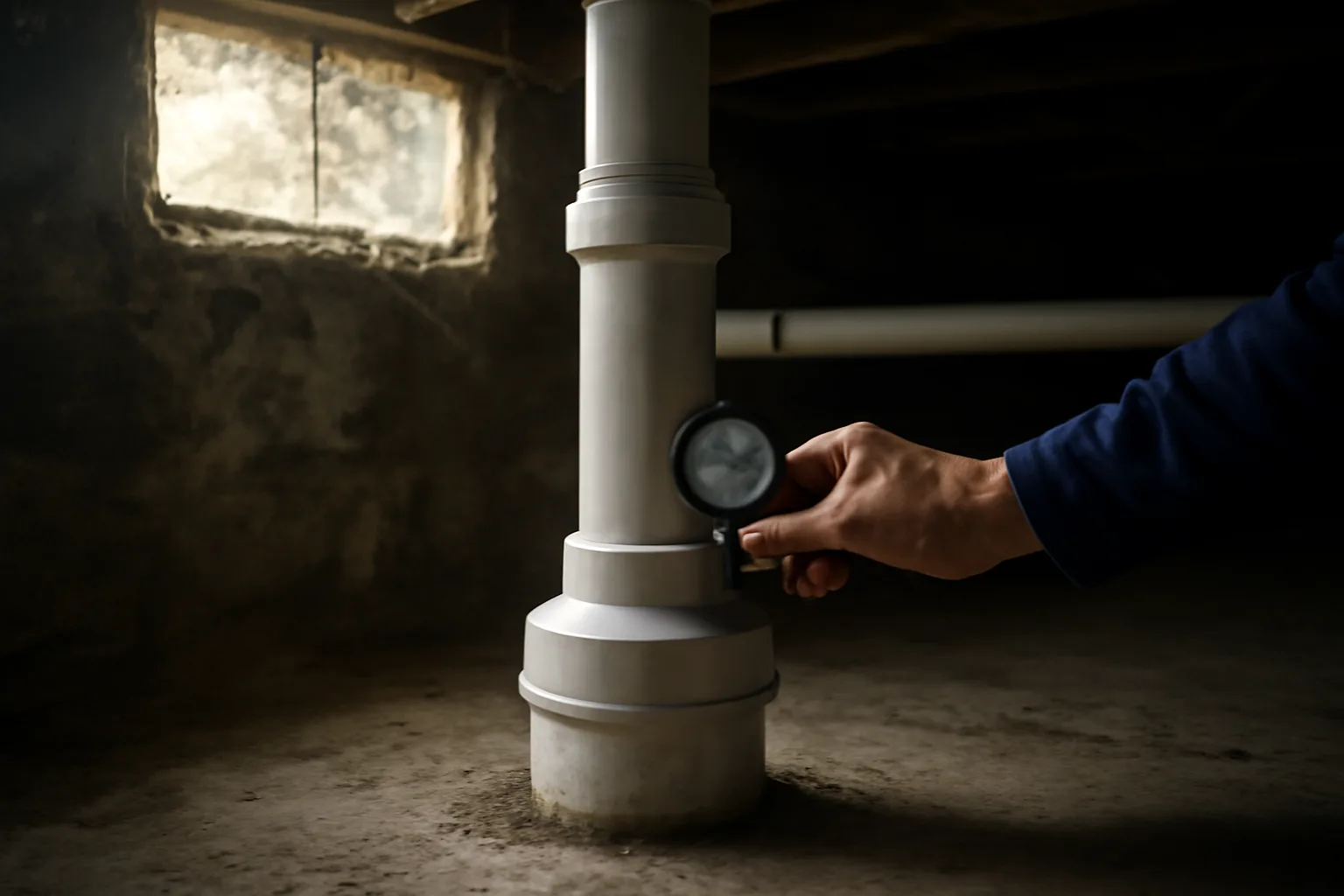
Nearly every Alaska radon mitigation system is active soil depressurization (ASD) with a sub-slab suction point. You cut a 4- to 6-inch hole through the concrete floor, excavate a small pit beneath, run schedule-40 PVC vertically through the hole, and attach an in-line centrifugal fan rated for continuous duty. The fan runs 24/7, pulling soil gas from under the slab and exhausting it above the roofline.
Freeze protection matters here. Discharge pipes have to drain condensation properly, and fans should mount inside conditioned space or in an insulated enclosure if they go in an attic. Outdoor fan mounts in very cold regions risk ice buildup. Many installers wrap exposed PVC in foam insulation and add a backflow prevention valve. The Alaska Weatherization Assistance Program and local building codes may require these steps if the home is weatherized.
You also install a manometer, a U-shaped tube, to show system pressure and prove the fan is running. That's your homeowner compliance tool. Then you seal large slab cracks with polyurethane caulk and test the system with a smoke pencil or micro-manometer to confirm the pressure field reaches across the whole slab.
What insurance and contracts do radon mitigators need in Alaska?
No state agency requires radon mitigation contractors to carry liability insurance. No smart contractor skips it. One misdrilled hole into a buried post-tension cable can destroy a slab and run a six-figure repair bill. General liability for a radon mitigation business in Alaska typically costs $600 to $1,500 a year for a $1 million occurrence limit, depending on revenue and claims history.
You also want errors and omissions (E&O) coverage if you offer radon testing, though many new mitigators start by partnering with certified testers instead of running tests themselves. Workers' compensation is legally required if you hire any employee, even part-time [10]. A sole proprietor with no employees can opt out in Alaska, but you have to file an exemption form.
Your contract should spell out scope, warranty period (one year for the fan and five years for system performance is common), and a post-mitigation testing obligation. Many Alaska homeowners expect a short-term follow-up test within 30 days. Quote it clearly. You're guaranteeing the system will hold radon below 4 pCi/L under normal operating conditions, not that the fan lasts forever.
How do I get my first radon mitigation clients in Alaska?
Alaska's small population amplifies reputation. One botched mitigation in Eagle River and you've got three real estate agents who won't call again. Start by getting listed in the NRPP and NRSB certified-professional directories. Then reach out to home inspectors in Anchorage, Fairbanks, Wasilla, and Juneau. They often need mitigators to handle the follow-up after a real estate radon test.
Real estate agents are the primary referral pipeline. Offer a free lunch-and-learn for a broker's office on radon risk and mitigation basics. In a state where about a third of homes test high, agents want a certified crew they can trust. Build a simple one-page site with your certification number, license number, and a few before-and-after pipe photos. Local Facebook groups and Nextdoor (in larger towns) work better than you'd expect.
Print materials matter less than a short, honest phone call. When a homeowner calls, explain what you'll do, give a ballpark over the phone and confirm it after a site visit, then show up on time. In Alaska, that alone still makes you stand out.
What is the first-year checklist for an Alaska radon mitigation business?
Here's a bare-bones, get-legal-and-working checklist:
1. Form your business entity (sole proprietor, LLC, or corporation) with the Division of Corporations. 2. Get your Alaska business license ($50 a year) through DCCED. 3. Buy a self-study or classroom NRPP mitigation training course. RadonPath's $149 NRPP Mitigation Kit is the lowest-cost option that meets the education requirement. 4. Pass the NRPP Mitigation Certification exam and submit your mentored system installation report. 5. Buy or lease a core drill, hammer drill, basic plumbing tools, a manometer, smoke pencil, and PVC supplies. 6. Secure general liability insurance, and file a workers' comp exemption if you're solo. 7. List your business in the NRPP and NRSB certified-professional directories. 8. Create a contract template and a warranty document. 9. Contact 10 local home inspectors and real estate agents by email or phone. 10. Complete your first paid mitigation, then order a follow-up test right away. 11. Open a separate business bank account and track every expense for tax time.
This list won't guarantee revenue. But hit every item and you're legit, insured, certified, and capable, which is more than half the people calling themselves radon mitigators in Alaska can say.
Frequently asked questions
Do you need a license for radon mitigation in Alaska?
No. Alaska has no state-level radon certification or licensing requirement. Alaska DEC guidance states “Alaska does not have a radon professional certification or licensing program.” [1] You do need a general Alaska business license from DCCED and, in practice, national certification from NRPP or NRSB to get insurance and client trust.
How much does radon mitigation cost in Alaska?
Alaska DEC says a residential radon mitigation system usually costs $1,500 to $3,000, varying by home size and design [6]. The national average is about $1,200 [7]. Most new Alaska contractors charge between $2,000 and $2,500 for a standard sub-slab depressurization install.
How long does radon mitigation take in Alaska?
A typical residential mitigation is a one-day job, about six to eight hours on site. Complex systems or permafrost-related issues can require a second day. The seasonal window for exterior work runs roughly May through October.
Can I do radon mitigation in Alaska without any certification?
Legally, yes. Practically, no. You won't get liability insurance, home inspectors won't refer you, and you'll have no way to prove competence if a system fails. Get NRPP or NRSB certified before you drill your first hole.
How do I get certified to do radon mitigation in Alaska?
Take an approved NRPP or NRSB course, pass the certification exam, and complete a field installation under a mentor. RadonPath's $149 NRPP Mitigation Kit is a self-study option that prepares you for the exam. The process takes 1 to 3 months.
What kind of insurance do radon mitigators need?
At minimum, general liability with a $1 million occurrence limit. It typically costs $600 to $1,500 a year for a solo operator. Workers' comp is required if you hire employees; sole proprietors can file an exemption. E&O is recommended if you also offer testing.
Is radon mitigation a good business in Alaska?
Yes, if you're certified and reliable. With 1 in 3 homes testing high [3], demand stays steady, especially in Anchorage and Fairbanks. The small population means reputation matters enormously, but a one-person operation billing 2 to 3 jobs per week can gross six figures a year.
Do I need a contractor's license for radon mitigation in Alaska?
No. Alaska does not require a contractor's license specifically for radon work. You only need a general business license from DCCED, which costs $50 a year [5]. If you expand into other home improvement work, a contractor's license may apply.
What equipment do I need to start radon mitigation?
Core drill, hammer drill, PVC cutters, pipe wrenches, manometer, smoke pencil or micro-manometer, caulk gun, and basic safety gear. Fans and schedule-40 PVC pipe are bought per job. Initial tool investment is typically $1,500 to $2,500.
How many radon mitigation companies are in Alaska?
There's no official count. NRPP's certified professional directory lists roughly 20 to 30 credentialed mitigators statewide, mostly around Anchorage, Mat-Su, and Fairbanks. The number climbs if you count uncertified handymen, but real competition comes from only a handful of established shops.
Can I test and mitigate radon in the same home?
Yes, but if you do both as a business, you need separate certifications: NRPP Measurement Certification for testing and NRPP Mitigation Certification for the fix. Many new mitigators offer only mitigation and refer testing to an independent certified measurement provider to avoid conflict of interest.
What's the average radon level in Anchorage homes?
Alaska DEC test data doesn't break out a city-specific average, but the department reports more than 1 in 3 homes statewide test above 4 pCi/L [3]. Anchorage soils are glacially derived with high uranium content, so indoor levels often exceed 10 pCi/L in untested homes.
Sources
- Alaska DEC Radon Professionals page: Alaska has no radon professional certification or licensing program.
- EPA Map of Radon Zones, Alaska: Most of Alaska's populated counties are EPA Radon Zone 1, with predicted average indoor radon screening levels >4 pCi/L.
- Alaska DEC Radon in Alaska page: More than 1 in 3 homes tested in Alaska have radon levels above the EPA action level of 4 pCi/L.
- Alaska DCCED Business Licensing main page: All businesses operating in Alaska must obtain a state business license.
- Alaska DCCED Business Licensing Fees: The annual business license fee is $50 for a sole proprietor.
- Alaska DEC Radon Mitigation page: The cost of a radon mitigation system can range from $1,500 to $3,000 depending on the size and design of the home.
- U.S. EPA Radon Mitigation Costs page: The national average cost of a radon mitigation system is about $1,200.
- EPA Radon page: NRPP and NRSB are the national radon professional certification programs recognized by EPA.
- NRSB Certification Requirements: NRSB certification requires completion of a training course, passing an exam, and documented field experience.
- Alaska Department of Labor, Workers' Compensation: Workers' compensation insurance is required for Alaskan employers; sole proprietors may file an exemption.